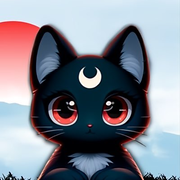
Tsuki: The Moon Cat, and Why Cats Belong to the Moon
Tsuki means moon in Japanese. Cats have been tied to the moon for as long as people have written either of them down — here is why.
What the word means
Tsuki (月) is simply the Japanese word for moon. It is one of the oldest words in the language and it turns up everywhere: tsukimi (月見), moon-viewing, is still an autumn festival where people eat dumplings and look at the harvest moon.
It is also the name of the black cat this game is built around, and the mascot of the $TSUKI community on Solana.
Black cats are LUCKY in Japan
This surprises people raised on the Western superstition. In Japan a black cat is a good omen — associated with warding off misfortune and, for shopkeepers, with drawing custom. The maneki-neko is made in black specifically as a protective charm.
The unlucky-black-cat idea is medieval European, and it did real harm. The full history is here →
Why the moon, and why cats
Cats are crepuscular — most active at dawn and dusk — and their pupils visibly open and close like a phase. Cultures that never met each other landed on the same association: the animal that changes with the light belongs to the light that changes.
The moon also carries the idea of return: it is eaten and comes back, every month, forever. That is the same idea as nine lives — a thing that should be gone and is not.
Moon cats and moon goddesses elsewhere
The pairing is not only Japanese. Diana, Roman goddess of the moon and the hunt, is the reason the name turns up on moon cats at all; her Greek counterpart Artemis was identified by later Greek writers with the Egyptian cat goddess Bastet, which is how a moon goddess and a cat goddess ended up sharing a shrine in the ancient imagination.
In Norse myth Freyja’s chariot is drawn by cats. In Scotland the Cat Sìth walks between the living and the dead. The cat is nearly always the one who moves at night.
The eclipse, told as a monster
When the moon disappears, the stories agree remarkably well: something ate it. A Hindu tradition has Rahu swallowing it; a Chinese one a heavenly dog; Norse myth has the wolf Háti chasing it down. Japanese myth gives us Yamata-no-Orochi, the eight-headed serpent — a serpent big enough to swallow anything.
Every version ends the same way: the light is taken, and then it is won back.
Where the game comes in
That last idea is the whole plot of this game, and it is the game’s own invention rather than anybody’s folklore: a shadow called Kage drains the moonlight one land at a time, Tsuki chases it across seven worlds, and it ends underground against Orochi. The myths above are real. The story is ours.
In the game
TSUKI: Nine Lives takes this history literally: you play Tsuki, a black cat marked by the moon, chasing the stolen moonlight across seven worlds while Orochi — the serpent that swallows the moon, the eclipse told as a monster — waits beneath the earth.
Keep Reading
You've read the codex. Now live it.
▶ PLAY AS THE BLACK CAT — TSUKI: NINE LIVESFree in your browser · 7 worlds · 63 levels · no install